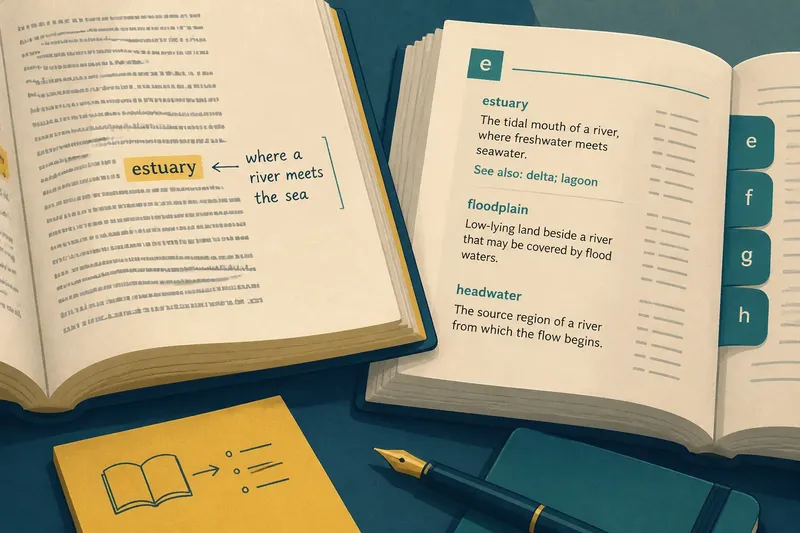
A Definition Is a Doorway, Not the Whole Room
A useful definition sets clear boundaries around an idea, while examples and context show how it applies, where it strains and what it leaves open.

A definition of a promise might say that it is a commitment to do, or refrain from doing, something. That sentence gives the idea a boundary: a promise is not merely a wish or a prediction. But it does not yet tell us what counts as a promise in a hurried conversation, how a promise differs from a contract, or what to make of a commitment no one can reasonably keep. A definition is a doorway into an idea, not a substitute for examining the room.
This distinction matters whenever we learn, teach or argue about a concept. A useful definition gives readers a shared starting point. Examples reveal how the concept behaves in particular situations; context shows why its boundaries matter. Confusing these jobs can make a definition seem either too narrow to be useful or so broad that it says almost nothing.
A definition draws a boundary around an idea
To define a concept is to say what belongs within it and, implicitly, what does not. A good definition is therefore selective. It identifies a feature that helps distinguish the idea from nearby ones, without trying to contain every detail that could ever matter.
Consider “neighbour”. In ordinary use, it often means someone who lives nearby. The boundary is practical, not perfectly fixed: a person across a landing may count, while someone across town usually does not. A dictionary-style definition can name the central relation, but a particular conversation may need to clarify whether “neighbour” means the next household, people on the same street or members of a local community.
That flexibility is not automatically a defect. Many concepts have a clear centre and less settled edges. “Tool”, for instance, readily includes a hammer or a screwdriver, but the status of a spreadsheet, a checklist or a shared calendar depends on what someone is doing with it. The definition can establish the general idea—an instrument used to carry out a task—without settling every borderline case.
Boundaries also make comparison possible. If a class distinguishes a promise from a prediction, learners can ask whether a speaker is committing to an action or merely expressing what they expect. The definition gives that question shape. It does not answer every case on its own, but without a boundary there is no stable basis for asking.
Examples show what a definition cannot carry
An example puts an abstract boundary into a recognisable situation. It lets a reader see which details matter and which are incidental. When a definition is the doorway, examples are the first views inside: useful, vivid and necessarily partial.
Imagine a colleague says, “I’ll send you the revised agenda before the meeting.” This is a straightforward instance of a promise: the speaker undertakes to do something. Now imagine the same colleague says, “The agenda should be ready before the meeting.” The wording may express an expectation rather than a commitment. Setting these sentences beside each other makes the distinction easier to notice than repeating the definition alone.
A contrasting example can be just as revealing. If someone says, “I hope the agenda is ready,” that expresses a wish, not necessarily a prediction or a promise. The words do not make the distinction in every possible context—tone and surrounding conversation can change how an utterance is understood—but they give learners a useful point of comparison.
Examples should illuminate the defining feature rather than smuggle in unrelated assumptions. If every example of a promise involves a formal agreement, readers may mistakenly conclude that promises require paperwork. If every example involves a friend, they may miss how the concept works among colleagues or public institutions. A small range of ordinary cases can expose what a single polished illustration hides.
Still, a collection of examples is not a definition. Readers may notice a pattern without knowing which feature is essential. They might infer that promises are always spoken aloud, because all the examples are spoken, or that they must concern a future action, overlooking commitments that take effect immediately. The definition identifies the intended boundary; examples help readers recognise it.
Context explains why the boundary matters
The same word can do different work in different settings. In an informal conversation, “I promise” may be a personal assurance. In a legal setting, a promise may be discussed in relation to obligations, evidence and enforceability. The everyday definition helps identify a family resemblance, but it cannot by itself explain the rules and consequences attached to a particular context.
Context includes the purpose of a discussion, the people involved and the conventions they share. A teacher defining “evidence” in a science lesson may be concerned with observations that support a claim. A historian may use the term for documents, objects or accounts examined to interpret the past. The central idea—material that bears on a claim—connects the uses, while the field determines what kinds of material count and how they should be assessed.
This is why a definition can be accurate and still leave a reader confused. “Evidence is information relevant to a claim” states a broad boundary, but someone may still ask what relevance means in a specific inquiry. Context supplies the working question: relevant to which claim, considered for what purpose, and under what standards? Those questions do not make the definition useless. They show what further explanation the situation requires.
Context can also expose stakes. Calling a remark a “joke”, a “threat” or a “promise” may affect how people respond to it. In disputed situations, a bare definition cannot settle what happened. The surrounding words, relationship, intention and applicable rules may all matter. Where the issue has legal consequences, general descriptions are no substitute for advice from a qualified professional.
How can you tell whether a definition is doing enough?
What makes a definition useful?
It separates the concept from close neighbours in language a reader can understand. If it simply repeats the word in different terms, or covers almost anything, it has not given the reader a workable boundary.
Should a definition include examples?
It can include one when a brief illustration makes an abstract feature easier to grasp, but the example should not replace the boundary. Keep examples separate when readers need to see how one idea applies across different situations.
What should you do with an unclear borderline case?
Identify the feature that makes the case uncertain, then ask whether the relevant context supplies a rule or a reason to draw the line differently. If the concept is genuinely open-ended, acknowledge that rather than forcing a false precision.
Can a definition change over time?
Yes: communities may extend, narrow or rework a word as practices and concerns change. A definition records a way of drawing the boundary; it does not make that boundary permanent.
Use definitions as starting points for better questions
When a definition feels incomplete, the next move is not always to add more words. First ask what kind of uncertainty remains. Is the boundary unclear? Would a contrasting example help? Does the reader need the rules of a particular setting? Each problem calls for a different kind of explanation.
Say you are preparing a short lesson on “feedback”. You might define it as information about a person’s work or performance, then show one comment that identifies a specific strength and another that points to a change. If learners still disagree about whether a mark alone counts as feedback, the useful next question is what the lesson means by information: must it explain something, or can a score serve that role? The definition establishes a starting boundary, the examples make it visible, and the question reveals where the boundary needs further discussion.
For your own reading, notice when a definition appears in a textbook, policy or conversation. Ask what it includes, what nearby idea it excludes, and which situation the explanation is meant to address. This small habit is more useful than trying to memorise a sentence without its purpose.
What is not worth the effort is polishing a definition until it anticipates every imaginable exception. That can bury the central idea beneath qualifications. Keep the definition clear enough to guide recognition, then let examples and context handle the cases that need them. A definition earns its place not by containing the whole subject, but by helping you see where to look next.