From Marginal Gloss to Modern Glossary
From marginal gloss to modern glossary: understand how each format supports reading, and choose the kind of explanation that best fits your study.
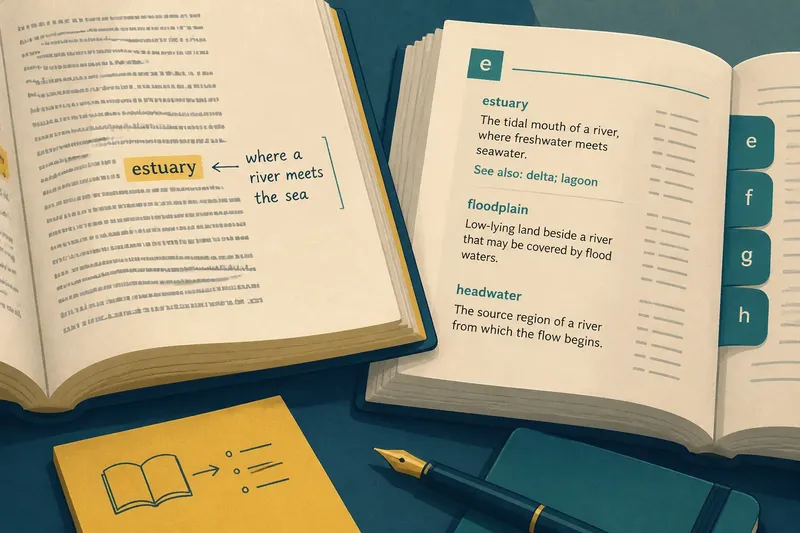
A marginal gloss explains a difficult word where it appears; a modern glossary gathers explanations for readers to look up separately. From marginal gloss to modern glossary, the change is not merely a matter of page layout: it changes whether help arrives during reading or by deliberate lookup.
Both forms can contain brief definitions, but they suit different moments. A note beside a word can keep a sentence moving, while a glossary can make terms easier to revisit and compare.
A gloss meets the reader at the difficult word
A gloss is a short explanation attached to a particular word or phrase. It might offer a synonym, translate an unfamiliar term, identify a reference or clarify how a word is used in its passage. In handwritten books, such notes could appear between lines or in the margin.
That closeness is convenient: readers need not search elsewhere for a prompt. But space is limited, and a single substitute word may help with the sentence without explaining the term’s broader meaning.
A marginal note may also belong to one particular copy of a text. A reader could write a personal reminder or correction, which a later reader might encounter without knowing who added it or why.
A glossary gathers explanations for lookup
A glossary collects selected explanations in a separate list, often arranged alphabetically. Its entries can give the same term a consistent explanation wherever it appears, and the separate space can accommodate context or a cross-reference.
Looking something up takes an extra movement: readers must recognise a difficulty, find the relevant entry and return to the passage. They also need to know which headword to seek. A word in a changed grammatical form, for example, may be listed under its base form.
A glossary makes editorial choices visible. Its compiler decides which terms to include and what kind of explanation to give. A list can be orderly without covering every difficult use; a familiar word used in an unfamiliar way may be just as confusing as a technical term.
Page design shaped where explanations could sit
Handwritten pages offered limited and uneven space. A marginal note had to fit around the main text, while a separate list offered another way to gather explanations. The possibilities depended on the book’s layout, the work involved in preparing it and the choices made by its makers.
The historical relationship between glosses and glossaries varied across books and periods. It is safer to describe a change in available forms than to claim that one format replaced another everywhere. Printing allowed material to be laid out as part of a prepared edition, but the broad claim that it made glossaries easier to reproduce needs qualification: the result depended on publishing practice, page design and the particular book. Marginal notes, glossaries and other explanations continued to coexist.
Digital reading adds other arrangements. A term may open a pop-up, link to an entry or remain in a separate list. These options change how readers reach help; they do not remove the underlying choice between an explanation placed beside the word and one gathered elsewhere.
It is not worth trying to assign every short note to a single historical stage or to treat glossaries as a clean replacement for glosses. A book can use a footnote, a glossary and a marginal explanation together, each serving a different purpose.
Choose the format that fits the reading task
A nearby note can suit a reader who wants a quick prompt without losing the sentence. A glossary can serve someone who expects to revisit terms, compare them or use them while studying. Neither is automatically clearer: a concise gloss may be direct, while an entry may offer more context, but either can still be vague.
Say you are reading a short account of river ecology and pause at “estuary”. A note beside the word says, “where a river meets the sea”. You use that hint to finish the sentence, then find that the passage also compares estuaries with other coastal environments. The glossary entry gives a fuller explanation and a cross-reference to those related terms. The immediate note helps you keep reading; the entry helps you follow the comparison. The useful choice depends on what the passage asks you to understand.
When an entry is unclear, check its wording against the sentence rather than treating it as a complete substitute for reading. If the entry still does not fit, return to the surrounding passage and consider whether the word is being used in a specialised sense.
Which form helps with this reading task?
What is the difference between a gloss and a glossary?
A gloss explains a particular word or passage, often in a margin or note. A glossary gathers entries in a separate place so readers can look them up.
Why are glossary entries often alphabetised?
Alphabetical order offers a familiar way to find a term whose name the reader already knows. A subject-based list may make related ideas easier to compare, but readers need to know which group to consult.
Can a glossary explain a word more fully than a margin note?
It can use its space for context, alternate senses or a cross-reference. More detail is useful only if it clarifies the word as it appears in the passage.
How should I use a glossary while studying?
Look up the term, read its entry, then return to the sentence and check whether the explanation fits. If the word recurs, note the passage that shaped your understanding rather than copying a definition without context.
Explanation depends on where attention falls
From marginal gloss to modern glossary, the central difference is where an explanation sits and how readers reach it. A marginal note meets uncertainty at the word; a glossary asks readers to pause and seek an entry. Each format selects what deserves explanation and leaves some interpretive work to the surrounding text.
When a term slows you down, ask what would restore your grasp of the sentence: a nearby hint, a fuller entry or a closer reading of the passage. That choice can make an explanation useful without asking it to do the work of the text itself.