A Quiet Hour with One Difficult Paragraph
A quiet hour with one difficult paragraph turns slow reading into clear notes: identify the claim, restate it plainly and name what still needs attention.
A quiet hour with one difficult paragraph can produce better notes than an hour spent rereading a whole chapter. The useful work is modest: identify what the paragraph claims, put that claim into your own plain language, then record what you still cannot explain. A pencil, the text and a blank sheet are enough.
Settle somewhere you can keep the paragraph in view, whether it is printed on a page or open on a screen. Give the session a clear boundary: one paragraph, not the surrounding chapter. The following sequence leaves room for uncertainty instead of disguising it as understanding.
1. Choose a paragraph with a real point of difficulty
Pick a paragraph that seems to carry an argument, distinction or explanation, rather than one that merely supplies background. A useful choice often contains a claim followed by a qualification, a reason or a consequence. If you cannot tell what it is doing, that is a good reason to work on it.
Copy the paragraph onto a separate sheet only if that helps you attend to its structure. Otherwise, mark its beginning and end lightly. Keep neighbouring text available for context, but do not let the session expand into a general hunt through the chapter.
Imagine you are reading a paragraph in a philosophy text that says a rule can shape a choice without determining it. The difficulty may lie not in the vocabulary but in the relation between “shape” and “determine”. That relation gives the hour a precise focus: what does the author allow the rule to do, and what does the author deny it does?
2. Read once without trying to solve it
Read the whole paragraph at an ordinary pace. Do not stop for every unfamiliar word or write a miniature commentary in the margin. On this first pass, notice where your attention catches: a contrast, a long sentence, a pronoun whose reference is uncertain, or a sentence that seems to change direction.
Then write a short note about the difficulty itself. “I lose the thread at the second sentence” is more useful than “This is confusing”, because it points to a place you can examine. If the paragraph feels opaque throughout, note that too; the uncertainty is information, not a failure of concentration.
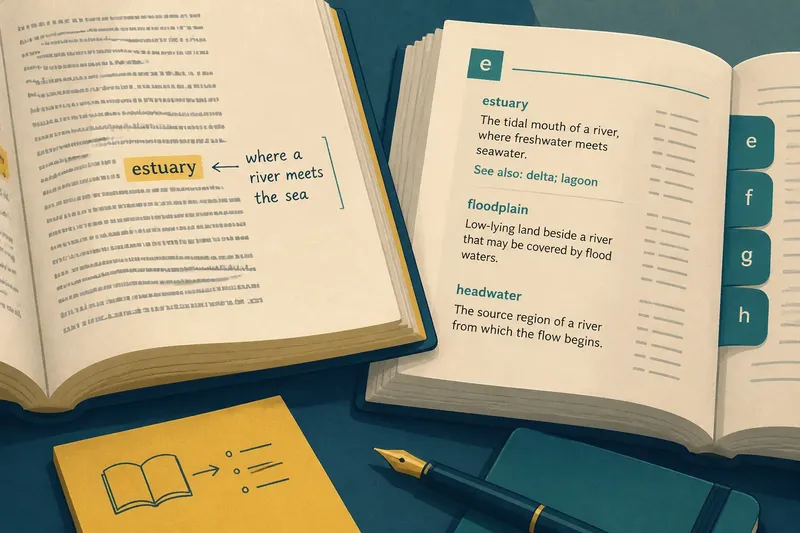
What is not worth the effort is looking up every term before you know which one matters. A dictionary can clarify a word, but it cannot by itself tell you how the author’s sentences fit together. Save that interruption for a term that appears central to the claim.
3. Mark the main claim in the author’s words
Read the paragraph again, this time looking for the sentence or clause that carries its main assertion. Underline only the smallest stretch that can stand as the claim. If two sentences seem equally important, mark both lightly and ask whether one gives the point while the other explains or limits it.
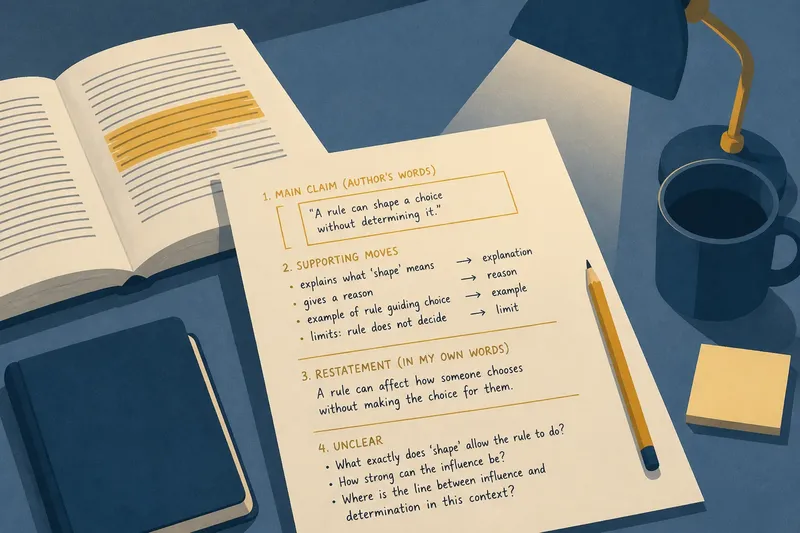
In the imagined paragraph about rules and choices, the main claim might be that a rule can influence a choice without settling it in advance. The surrounding sentences may explain what influence means or guard against the mistaken idea that the rule dictates every decision. Those details matter, but they are not automatically the central claim.
Beside the marked passage, write a compact label such as “claim” or “main point”. Avoid turning the margin into a second copy of the paragraph. The mark is there to identify the author’s commitment, not to settle whether you agree with it.
4. Separate the claim from its supporting moves
Look at what the remaining sentences contribute. One may give a reason, introduce an example, define a term or qualify the claim. A qualification narrows what the author means; it should not be mistaken for a retreat from the argument unless the wording supports that reading.
Use a small number of margin marks if they help: “reason”, “example” or “limit”. Keep the labels tentative. If a sentence seems to do two jobs, record both rather than forcing it into a neat category. The point is to see the paragraph’s shape, not to make every sentence fit a rigid scheme.
For the rule-and-choice paragraph, a later sentence might clarify that people still make decisions, while the rule makes some choices easier to recognise or justify. That could be an explanation of the claim, not a separate claim that rules remove choice. Distinguishing the two keeps a familiar word such as “influence” from doing more work than the text gives it.
5. Restate the claim in plain language
Cover the paragraph or look away from it, then write one sentence that states its main claim as you currently understand it. Use ordinary words, but preserve the author’s limits. If the paragraph says “may”, do not turn it into “always”; if it draws a distinction, do not flatten the two sides into one.
For the imagined passage, a plain restatement could be: “A rule can affect how someone chooses without making the choice for them.” Compare your sentence with the marked claim. If your version adds an outcome the author never mentions, or removes a qualification, revise it. Plain language is a check on understanding, not permission to simplify away the argument.
Write the restatement separately from the original wording. That separation makes it easier to see whether you have translated the idea or merely swapped a few terms. If the sentence will not come, try writing what the author is not claiming; the contrast can reveal the boundary of the point.
6. Name what remains unclear?
What if I cannot find one main claim?
Mark the two strongest candidates and describe the difference between them. The paragraph may be presenting a contrast or building towards a claim in stages, rather than placing its point in one tidy sentence.
Should I look up an unfamiliar word?
Look it up when the word appears central to the claim or changes how you understand a key sentence. Note the meaning that fits the passage, and leave peripheral vocabulary for another time.
How do I know whether my restatement is accurate?
Check whether it preserves the paragraph’s subject, its main assertion and any important limitation. If you cannot point to words in the passage that support part of your sentence, mark that part as your inference rather than the author’s claim.
What should I do if the paragraph still resists explanation?
Write the precise question you cannot answer, such as “What does ‘influence’ refer to here?” Keep the question beside your notes and stop short of inventing an answer that the paragraph does not provide.
On the blank sheet, make a final note headed “Unclear”. List only the questions that remain after your restatement: perhaps an undefined term, a missing link between sentences or an assumption you do not yet recognise. If context is needed, identify exactly what to check later, such as the sentence immediately before the paragraph or a definition earlier in the chapter.
7. Close the session with a usable record
Bring the page together in three brief lines: the author’s main claim, your plain-language restatement and the uncertainty that remains. Add a reference to the paragraph’s location so you can return to it without searching. Keep your own question distinct from the text’s stated claim.
In the imagined reading session, the record might say that rules influence choices without determining them; in plain language, a rule can affect a decision without making it; and the open question is what kind of influence the author has in mind. That last note gives a later reading a specific task rather than a vague instruction to “understand the chapter”.
A quiet hour with one difficult paragraph is useful when it ends with an honest account of both comprehension and doubt. The point is not to make every passage yield at once. It is to leave with a claim you can state, a reasoned reading of its limits and a question clear enough to carry forward.